PiEvo
Principle-Evolvable Scientific Discovery via Uncertainty Minimization.
PiEvo: Principle-Evolvable Scientific Discovery via Uncertainty Minimization
2 Zhejiang University
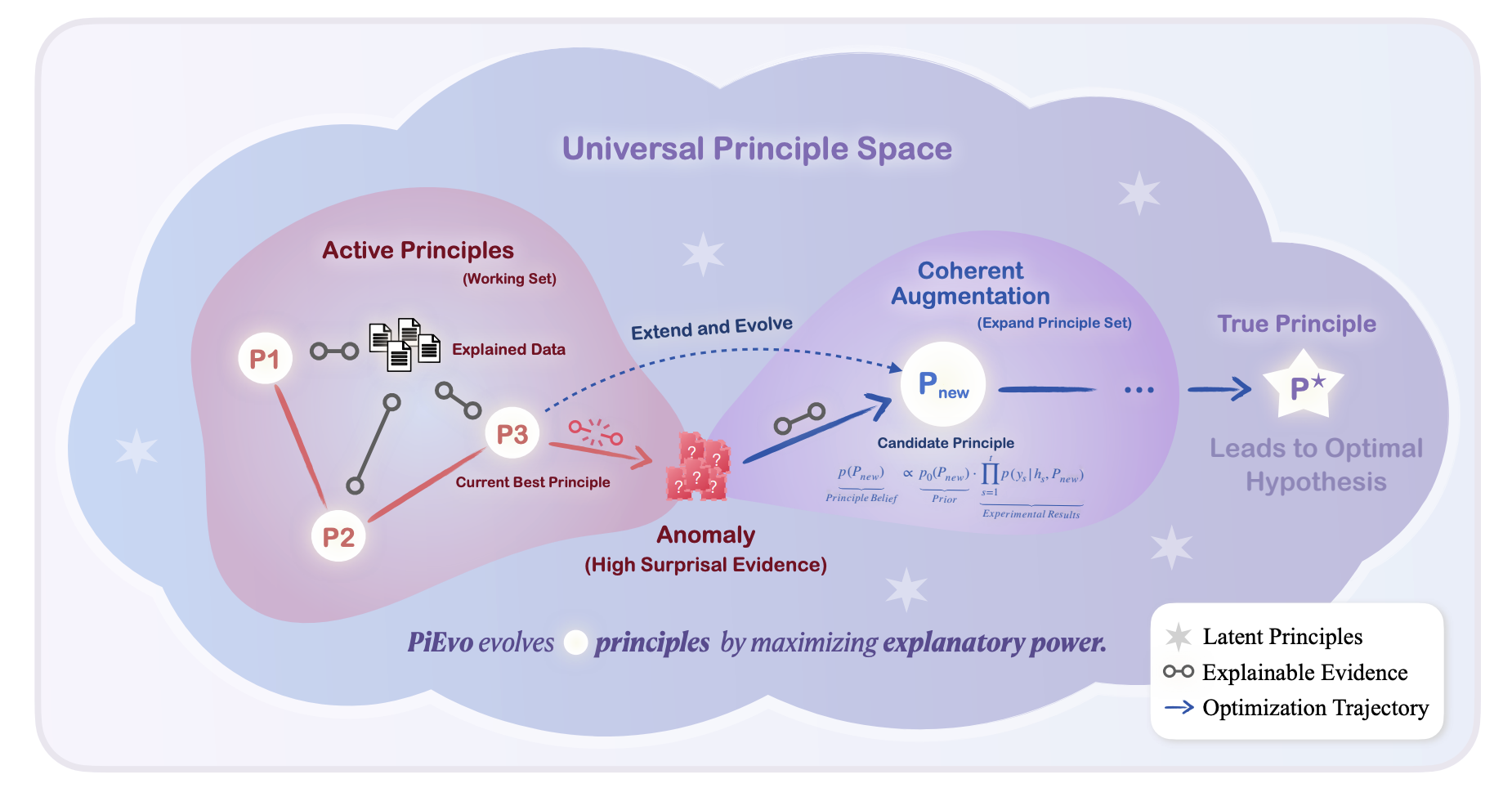
The PiEvo framework: A Bayesian-inspired dual-loop system for evolving scientific principles.
Large Language Model (LLM)-based scientific agents often suffer from inefficiencies due to fixed initial priors and static hypothesis spaces. We propose PiEvo, a principle-evolvable framework that treats scientific discovery as Bayesian optimization over an expanding principle space. By integrating Information-Directed Hypothesis Selection (via Gaussian Process) and an anomaly-driven augmentation mechanism, PiEvo enables agents to autonomously refine their theoretical worldview. Evaluation across four benchmarks (physics, chemistry, biology, and materials science) shows that PiEvo improves solution quality by ~30% over state-of-the-art methods and achieves an 83.3% speedup in convergence.
Evolvable Principle Space
PiEvo moves the paradigm of scientific discovery from searching in a static hypothesis space to optimizing an underlying, evolvable principle space. Key components include:
- Principle-Directed Selection: Using Bayesian updates to refine tentative principles based on experimental evidence.
- Anomaly-Driven Augmentation: A mechanism that catalysts the expansion of the principle space when experimental outcomes significantly deviate from current predictions (high surprisal).
- Dual-Loop Optimization: Minimizing uncertainty across the "Principle → Hypothesis" and "Evidence → Principle" pathways.
Performance & Convergence
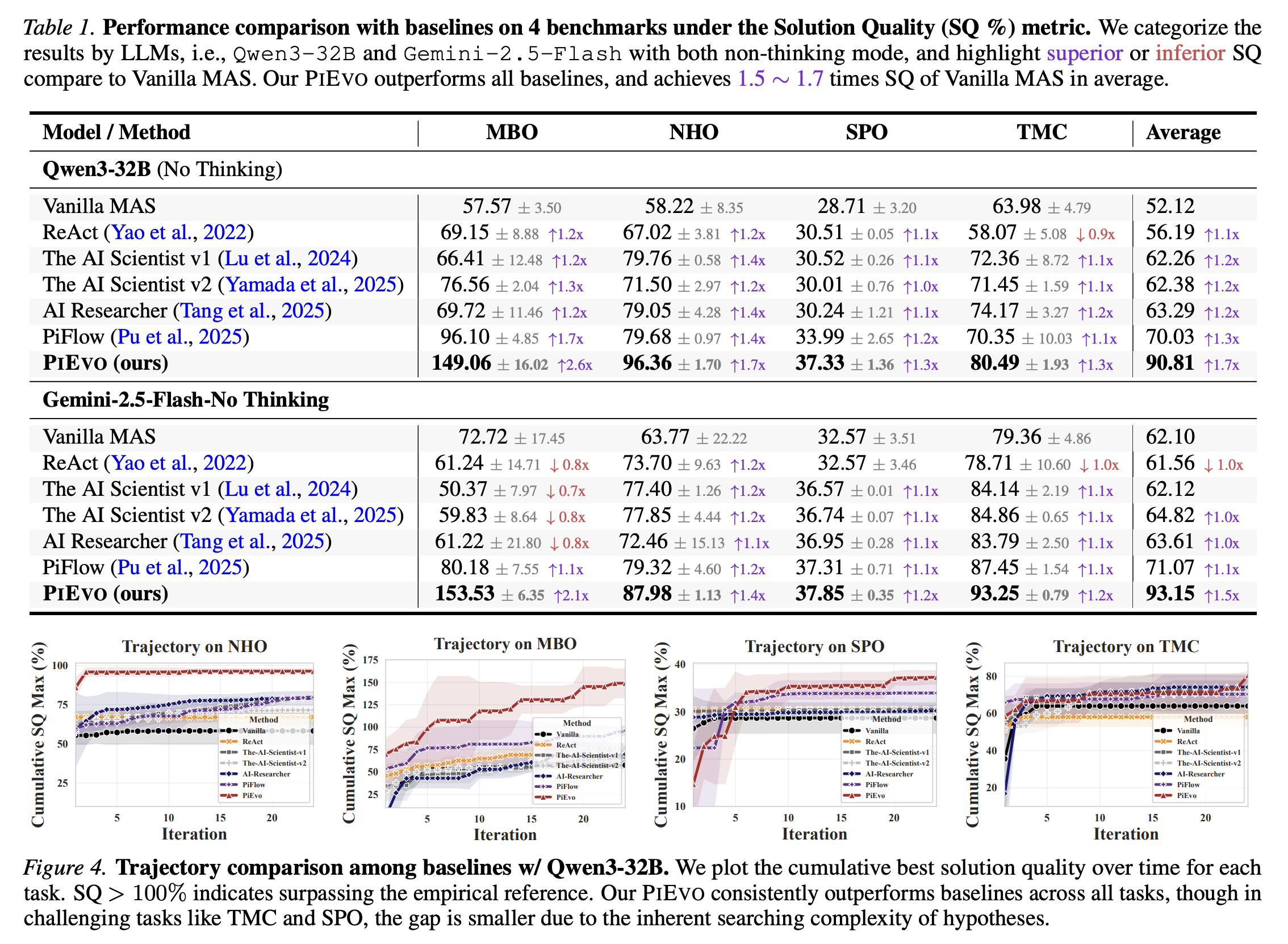
Quantitative results demonstrating PiEvo's superior solution quality and faster convergence across multiple scientific domains.
◊ Key Result: PiEvo achieves an average solution quality of 90.81%–93.15%, outperforming previous SOTA methods by up to 31.1% while attaining an 83.3% speedup in convergence.
Case Study: Advanced Electrodynamics
In a blind case study involving sub-wavelength chiral optics, PiEvo successfully identified novel electrodynamic mechanisms, specifically the toroidal-electric quadrupole interference. This discovery was made possible by the system's ability to "think outside the box" when faced with anomalous FDTD simulation data, evolving its theoretical understanding to include higher-order multipole interactions.